It’s time to say goodbye to poor dental hygiene and worse weather and say hello to German efficiency and soft pretzels!
When we were planning our European leg of this trip many months ago I quickly put Munich in late September on the map. This might be our only chance to go to Oktoberfest, so in a rare example of EXTREME planning, I took the reins and got everything figured out.
But Germany is much more than just Oktoberfest, so we booked a car so we could drive all over. Our road trip looked something like this.

Munich
We were in Munich mostly for Oktoberfest celebrations, but that doesn’t mean that’s all Munich has to offer. For being almost completely leveled in WWII, Munich is a beautiful city with a lot to offer and explore. Including delicious baked goods. This might have been the best one Hayley had on the entire trip. It was so good we came back multiple times during the week.

The famous, and original, clock with dancing statues. Every hour on the hour people gather out front to hold up their recording devices as the dance takes place.


We didn’t expect to see a Red Wing Shoes store right near our metro stop. Germans know good shoes when they see them.

The May Day Pole has pagan roots, dedicated to the new and prosperous upcoming Spring. Not sure if this is exactly a May Pole. but it looks pretty close.

BMW Experience
We aren’t huge gearheads but we know German engineering is pretty darn good, which is why we did the BMW tour. While we couldn’t take photos inside the manufacturing plant, we took a few in the showroom. If you get a chance to do this tour, please do.


The manufacturing plants were incredible to walk through. First we went to the press plant. That’s where giant presses press sheets of metal into shapes like fenders, roofs, trunks, and whatnot. The process basically looks like this, but with way fewer people.
Also please remember these factories are HUGE. They have several football fields of square footage. BMW is the largest payer of property tax in Munich. Big, big factories.
After leaving the press plant we toured through what most of us would recognize as putting the car together. This part of the manufacturing process was completely controlled by machines. It looked something like this.
The above tour is interesting and accurate. One of the most impressive aspects is how they don’t manufacture one type car at a time. On the assembly line it is a wide variety of vehicles, so the robots have to be programmed to work on different models all the time.
After that we stopped by the paint shop, which was difficult to see because of the over spray in the painting room but still interesting. It’s completely controlled by robots. They prime, paint, coat, and check for dull spots. The robots use mirrors and powerful lights to gauge the reflection of the paint. They buff it and everything – humans just turn the switch on.
We moved on, after that, to engine assembly. This process still had plenty of humans putting the right parts in the right places. They were putting in pistons, rods, valve springs, cam shafts, all that sort of thing. Humans were also busy installing seats and, if memory serves me, wheels and doors.
The whole process was super interesting. If you like cars or are just interested in how things are made, a car factory tour should be on your list.
Oktoberfest
Oktoberfest is the party you think it is. Living in Winona, we’re familiar with LaCrosse’s Oktoberfest shenanigans. And while they’re a lot of fun and impressive, the original Oktoberfest in Munich is world class.
A quick note about Oktoberfest we didn’t realize. It isn’t a German thing, per say – it’s a Bavarian thing. We’ve heard from several non-Bavarian Germans that they either don’t celebrate Oktoberfest or they think the Bavarians are just goofballs. But in recent years Oktoberfest has become so popular that other German cities are taking the opportunity to throw a festival as well.
This is in stark contrast to German-Americans who celebrate Oktoberfest whether or not they’re actually Bavarian. Whatever the case, German or not, if you have a chance to go to Oktoberfest we can only say: Go!

We went in the middle of the week, just around lunchtime. This is our advice to you if you end up going: pick a slower time, unless you enjoy hoards of people. Imagine being at the Minnesota State Fair but with twice the people. It gets packed. Less popular times help you enjoy the beer tents to their full effect.
We went to Schutzen-Festzelt, which was fantastic.

Most of the seating is by reservation only. We were able to get some seats, packed in with other random folks, by asking the waiter if they had any unreserved places. It only worked because it was two of us. For more than two you’re better off reserving a table. Just beware the price is high: in order to reserve, each person has to consume 2 beers and a half a chicken – which ends up being 40 or 50 dollars per person. At least that’s what it was in our beer hall.

The beers are delicious and large, 1 liter.

They’re expensive, too. That’s not just our opinion – the locals around us were complaining about the price, which goes up almost every year. In the prices below, you’ll see each beer is 11.40 euro for 1 liter. You can buy premium Bavarian beer in the grocery store for 1 euro per 500ml bottle.
And speaking of beer options, we loved how many options our tent offered: beer, raddler (beer and lemonade), and alcohol free beer. That’s it! No tough decisions, no Double Black IPAs or anything stupid like that, you get a BEER!

You have a lot of tents to choose from. We’re very happy with our choice. It’s right next to the gigantic Bavaria statue.


For ethnic Bavarians (and cheeky tourists), they’ll wear traditional lederhosen, which is deer leather pants. They’ll throw in an alpine hat and a vest over a checkered button-up and they’re good to go. Very festive.


Road Trip Begins
A quick couple of words about driving in Germany. Overall it is very nice. The roads are well maintained and the signs are easy to follow. It was a night and day difference from the UK. The signage there was terrible, the roundabouts were plentiful and complicated.
Anyway, certain stretches of the autobahn indeed have no speed limit. There are probably other laws you can break by driving too fast if you’re reckless, but overall people drove fine. The average speed limit was about 80 to 85 MPH and it felt comfortable.
Germans know how to drive. Not that Minnesotans are bad drivers, but it was noticeably different from driving in Minnesota. Germans are much more serious about efficiency on the road. In Germany you can not be in the passing lane unless you are passing. And even if you’re going fast in the passing lane, you must move over when someone behind you wants to pass. Other drivers are strict about the rules, so if you disobey you’ll get honked at, lights flashed at, and plenty of dirty looks. Obey the rules of the road and keep the traffic moving.
Plus, when traffic jams pop up and slowing down is unexpected, drivers put on the hazards. It’s a communal experience.
Anyway, if you were wondering, yes I drove as fast as I could. My land speed record is 112MPH, which felt very, very fast. I had a long stretch of downhill highway in front of me and gave it my best shot. This is the no speed limit sign.

One more interesting tidbit. At one point we had to put air in one of our tires. I made it to a fuel station and looked at the air machine, only to be confronted with no indication of what PSI (Pounds per Square Inch) I needed. The air machine showed only barometric pressure, which, I’m guessing, is what the metric system uses to measure air pressure, since they don’t use inches or pounds.
So I looked on the tire, which was completely in English, and it said a Max PSI of 44 with no indication of what barometric pressure they should be. Luckily we did a little conversion on Google to find out we needed 2.2 barometric pressure. How weird is that?
Salzburg
Technically not in Germany, Salzburg is so close to the border that a trip to southern Germany isn’t complete without stopping by for a visit. Salzburg is the home of Mozart and much of the inspiration for The Sound of Music. It’s probably the most picturesque city in Austria.
Here we are in front of Mozart’s statue listening to Rick Steve’s tour – highly recommended.

Southern Germany and western Austria have many Baroque style churches. The bulbous steeples are a indication of Baroque style.


Eagle’s Nest
Just outside of Salzburg, The Eagle’s Nest was one of Hitler’s private residence. It’s located at the top of a mountain and was an engineering miracle to construct.
Here we are at the entrance which leads to the polished brass elevator – no photos allowed there, unfortunately.

This place was a really big deal during WWII. American troops were in a race to capture the residence. When they arrived, Hitler was elsewhere, but the troops got to enjoy some of the Führer’s wine.


The Eagle’s Nest is now in private hands and is a restaurant. Weird huh?


Island City Brewery is a brewery in Winona! We just happened to see the sticker by chance.

Driving Through the Alps
It’s hard to decide which was more visually stunning: driving through the Scottish Highlands or the German Alps. We ended up taking a few detours because the main highway along the southern portion of Germany was closed for renovation.
This ended up being a blessing in disguise because we were able to take some very windy, very narrow roads. Many hairpin turns and mountain peaks. What a treat.


And of course, we stopped in a few bergs (towns) to check out their culture. This little town is world famous for putting on the Passion of the Christ in person each year.


This gentleman had the largest cast iron pan we’ve ever seen.

Hohenschwangau
We’re not even sure how to pronounce this city’s name but we can bet you know something about it.

That’s right. This is the castle for the inspiration to Sleeping Beauty. It was very rainy when we got there and they didn’t let us take photos inside, so this was the best photo we could muster.

Freiburg
What a beautiful city center Freiburg has. The night before we investigated this town we stayed at a vineyard on the outskirts of town. It was the perfect setup to explore a historically German/French city.


Hornberg
It’s tradition to visit Hornberg, Germany whenever a Hornberg goes to Germany. This trip was no different. Basically, we went there just to walk through the small town and take pictures with random Hornberg signs. Besides that, there isn’t much to do. 

Friedberg
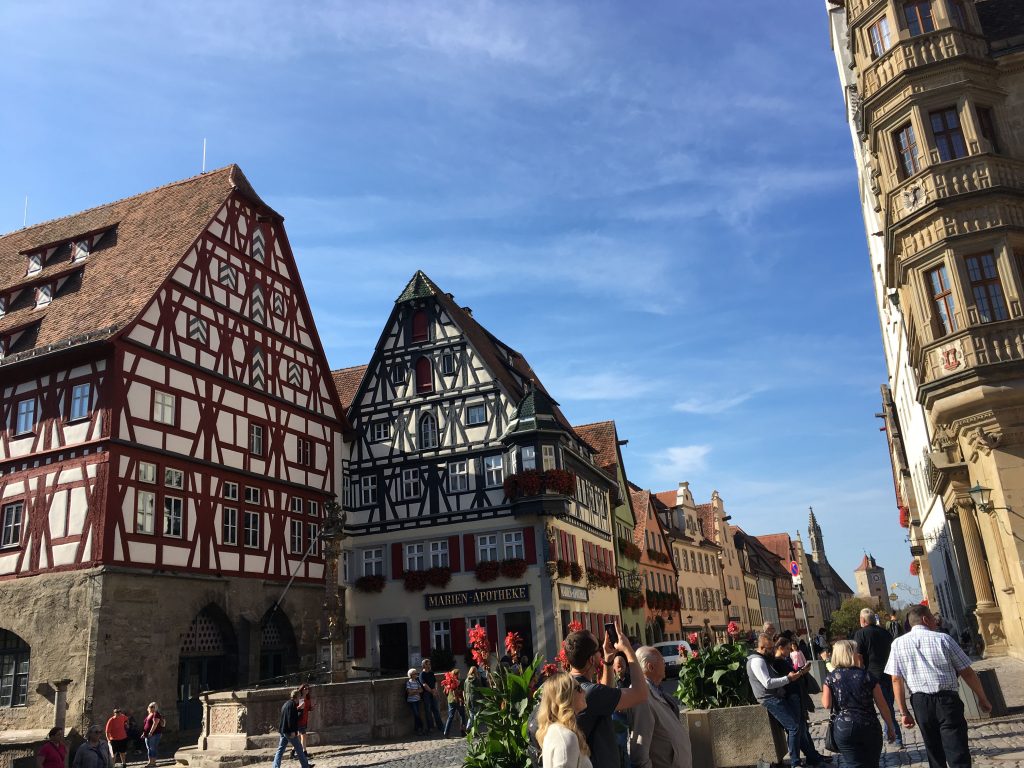
With a name incredibly close to Freiburg, it is easy to confuse these two on the map. But where Freiburg had a beautiful city center, Friedberg is world renown for being completely original from centuries past. It was well preserved over the years and remains the historical German city to explore. Everything here is worth a picture.



Late Addition
After our initial German road trip, we went to Amsterdam and then Belgium. After Belgium, we flew to Berlin for a few days. We’ll add that outlier here in the main Germany post so things don’t get confusing.
Berlin
Having flown in from Brussels in the morning we were darn tired. But we arrived only to be greeted by a locked door and an unresponsive host. We had to stand out in the rain for an hour or so while we contacted her.

Everything was cured by a trip to the doughnut shop, of course.

No stop in Berlin without stopping by the Reichstag.

Or the Brandenburg Gate. Again, notice the headphones we wearing for the Rick Steve’s tour.

This was an oddball we didn’t expect to see but thanks to Rick Steve we were able to take a picture. This sculpture of Prometheus was done by Albert Speer, Hitler’s favorite architect. I’ve been reading Ascent which details how Hitler rose to power and I had just learned about Speer.
This sculpture of Prometheus being gnawed upon by a bird is a reminder of the sacrifices you must endure to defy the gods and advance humanity.

Right after the statue, we paid our respects at the Jewish Holocaust memorial. It’s a somber experience, especially since having visited Auschwitz and Birkenau.


A big, cool looking church. Not sure what it was about but Berlin has some classic architecture.

And let us finish off the day with the best deli sandwich we’ve ever had at a small deli called Mogg. Pulled pork and pastrami.


Oh yeah, and a pastry for dessert.

Conclusion
There you have it! Germany was a lot of fun and went by quickly, far too quickly! We hit everything we wanted to: Oktoberfest, delicious pastries, WWII history, beautiful sights, and more pastries.
With all that said, we give Germany…

That’s our review of Germany. Have you been there? Did you love it? Did you hate it? What did we miss? Let us know in the comments below.


Leave a Reply